
USB OTG (On-The-Go) is the ability for a single USB port to become both a Host and a Device.
What you can do when you run PL-R5 as a USB device
Ethernet, Serial, Storage realized with OTG
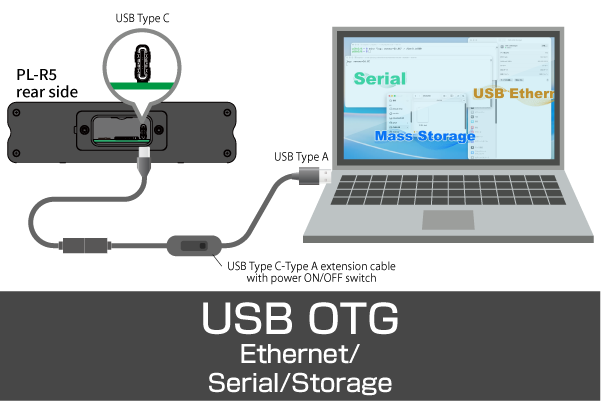


USB OTG (On-The-Go) is the ability for a single USB port to become both a Host and a Device.
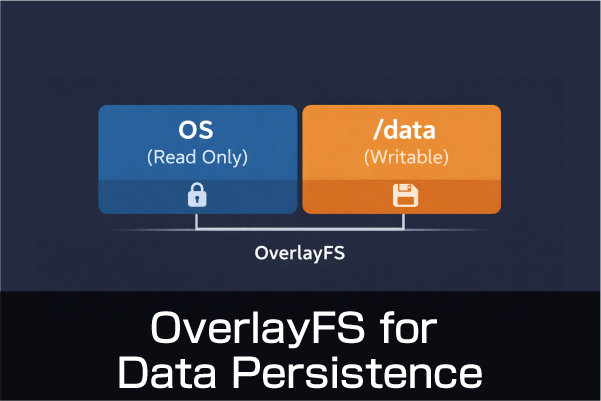
By making the OS part read-only, writing to storage is greatly reduced, extending the life of the storage media. In addition, it increases the probability of preventing damage to the OS part in the event of a sudden power failure.
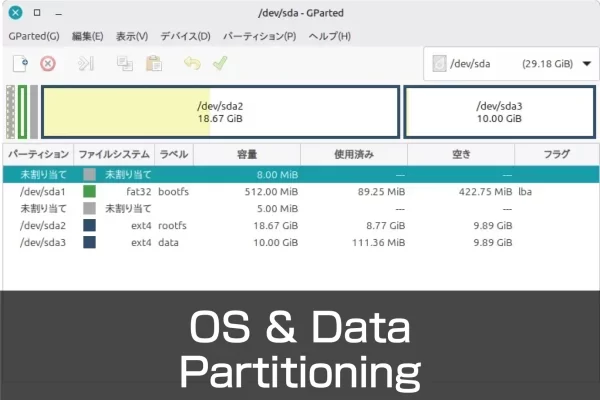
Partitions on external media can be modified while the system is running.However, the partition that the OS is currently running from cannot be modified directly.You must access it from another system. Here, the OS is written in Raspberry Pi Imager for use with Raspberry Pi devices such as Raspberry Pi 5 and CM5.The same partitioning procedure can be used for the Raspberry Pi OS as well as Ubuntu Desktop. Split into partitions Instead of partitioning from scratch, write the OS as usual with the Raspberry Pi Imager.Another partition is created after startup. Raspberry Pi OS Write Activate the written microSD card or other device as usual.Once activated on the Raspberry…
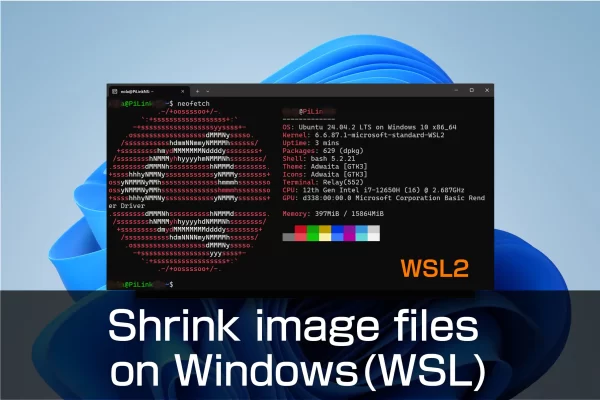
The PiShrink tool software allows you to reduce the size of the Raspberry Pi OS image file that you have backed up in its entirety beforehand. The reason why it is necessary to reduce the size of the image file is because the file size will inevitably become huge, making it difficult to save and handle. The backup image file for the Raspberry Pi Compute Module 4 that we have prepared is about 30 GB. Multiple backup files require even more storage space. Even if the files are stored in a different location, it will take a considerable amount of time to move or copy the files. If the file…

When we hear the words AI image processing and edge processing, we tend to imagine a large system, but in fact, Raspberry Pi is used in systems that are practical enough.

Speech recognition realized by connecting a microphone to a Raspberry Pi is effective for some applications and is not too expensive. If you only need speech recognition, which is different from spoken dialogue, you don’t need much machine specs. There are many speech recognition software, services, and libraries, both paid and free. We often see API services, especially from Google, Amazon, and IBM. Since we wanted to conduct this project in a local environment (offline), we considered “Julius,” which is highly efficient and versatile, and “VOSK,” which can be easily handled with a Python program. Both are free and easy to start. Since it is a local environment, there is…

Using TTS (Text To Speech) on the Raspberry Pi, you can make it speak from text in natural speech. Especially if it is a fixed short sentence, it can be played back in near real time even with the performance of the Raspberry Pi.

It is easy to imagine the case for connecting sensors to the Raspberry Pi for industrial applications. In particular, they are widely used for temperature and humidity control. When “visualizing” the acquired data, graphs and numerical tables are effective, but displaying the data overlaid on a drawing is more intuitive. This time, we realized it with Grafana.The following image is an example using test data in the database, but in reality data from sensors can be updated and displayed in real time. With the increase in extreme weather in recent years, many industries are facing challenges in dealing with heat.In the logistics industry, such as warehouses and distribution centers, as…

Introducing Tailscale, a cloud VPN service that can be used even from a Raspberry Pi!

The camera module that can be directly connected to the Raspberry Pi via a CSI connection can be used with the rpicam-still command, but a USB-connected webcam cannot.